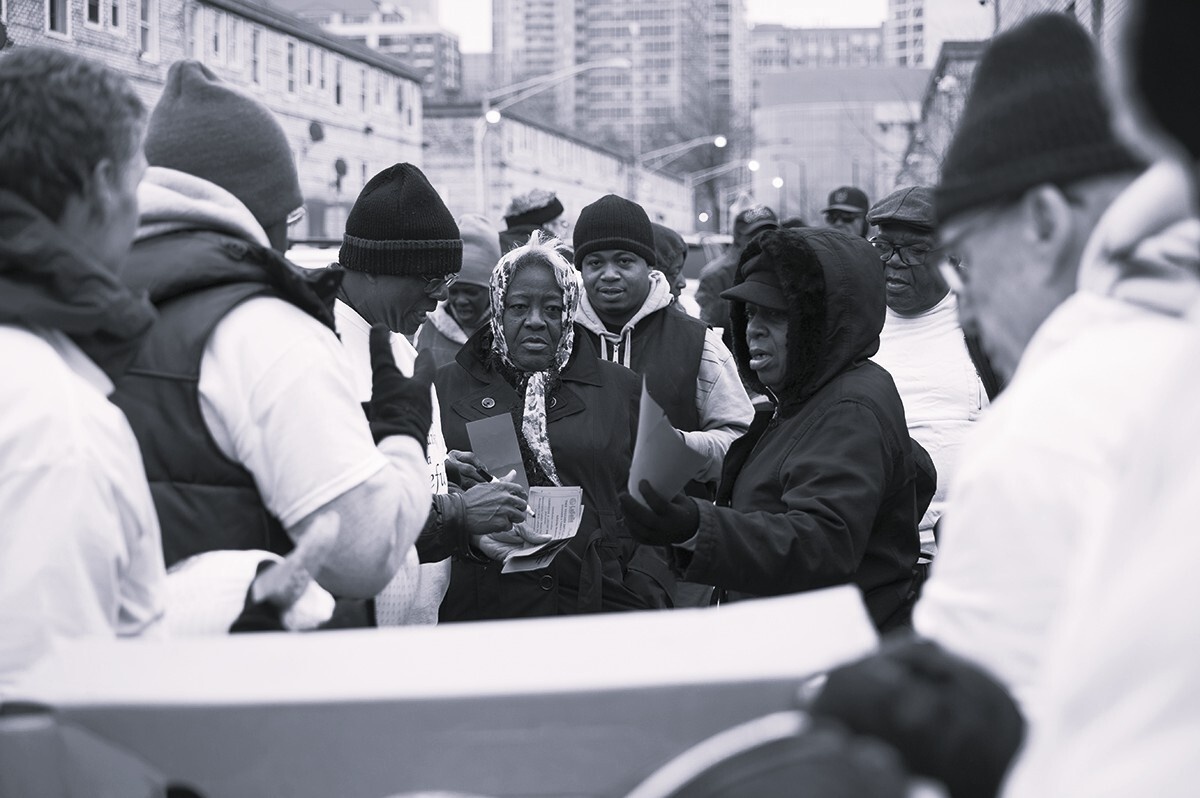
Against All Odds is a violence-prevention and peer re-engagement strategy designed to reduce the mental, physical and historical barriers that exist amongst longtime at risk and high-risk public housing residents that live on the north and south side of Division Street on Chicago’s north-side. The program focuses on people who have been most affected by decades of gang-related violence.
Over many years, this violence has created deep mental, emotional, and physical barriers within families and neighborhoods. These mental and physical barriers have caused grandmothers, fathers, mothers, brothers, sisters and entire local elementary classrooms to isolate themselves and live within a two-block radius of their home paralyzed by the fear to venture beyond the next block.
The program is built on research, data, and proven practices that show lasting change happens in three connected phases.
Phase I: Trust, Forgiveness, and Reconciliation
When structured processes like peace circles are used in communities shaped by conflict and resentment, people can begin to rebuild trust. This phase lays the groundwork for healing and shared transformation.
Phase II: Healing Trauma
When personal and shared trauma is addressed—both therapeutically and creatively—the cycle of violence weakens. Participants gain healthier ways to cope, communicate, and coexist.
Phase III: Creating Strong Situations for Unity
When people are placed in powerful shared experiences where division is difficult to maintain, genuine relationships can form. Over time, participants move away from an “us vs. them” mindset and toward a sense of community and kinship.
Changing the Situation to Change Behavior
The program is based on the idea that behavior cannot be changed directly—but situations can.
Psychologist Kurt Lewin expressed this as:
B = f(P, S)
- B = Behavior
- P = Person
- S = Situation (Environment)
Against All Odds focuses on changing the situation so healthier behaviors naturally follow.
Who the Program Serves
The program targets 12–24-year-olds, especially those with siblings attending local elementary schools. While 12-24-year-olds is the target, the program is not limited to this demographic.
Participants go through a guided journey of self-reflection, healing, and relationship-building. For older participants, the experience culminates with a visit to Robben Island in South Africa—where Nelson Mandela was imprisoned for 27 years and later emerged as a leader of reconciliation.
Program Timeline and Recruitment
- First Year:
Participants engage in deep self-reflection, trust-building, and forgiveness work. - Second Year:
Participants apply what they’ve learned by working directly with people they have long been in conflict with.
Participants are recruited through:
- The FLIP Program (Flatlining Violence Inspiring Peace)
- Returning citizens in the community
- Long-standing street-level relationships
- School principals from Jenner and Manierre
Outcomes
Graduates return to their neighborhoods as character-driven young men and women equipped to overcome adversity, rebuild relationships, and participate fully in both their local community and mainstream society.